dlinkap.local — D-Link Extender Setup & 192.168.0.50 Login
If you searched dlinkap.local expecting to open your D-Link extender, you are in the right place—but the page will only load when your phone or computer is connected directly to the D-Link extender. dlinkap.local is D-Link’s local setup address for its DAP-series and newer Wi-Fi extender models, while 192.168.0.50 is the default fallback IP address.
dlinkap.local is the local management URL for D-Link Wi-Fi range extenders, and 192.168.0.50 is the default IP address used when the extender is unconfigured or cannot detect a DHCP server.
Connect directly to the extender’s Wi-Fi network or Ethernet port, then enter one of these addresses in your browser:
| Access Method | Address | When to Use It |
|---|---|---|
| D-Link setup domain | http://dlinkap.local |
First choice for most D-Link DAP and Eagle Pro extenders |
| Factory default fallback IP | http://192.168.0.50 |
Use when the domain does not load or no DHCP server is detected |
- For older D-Link DAP models: Username:
Admin• Password: Leave blank - For newer Wi-Fi 6 models: Printed on device label or created during the initial setup wizard.
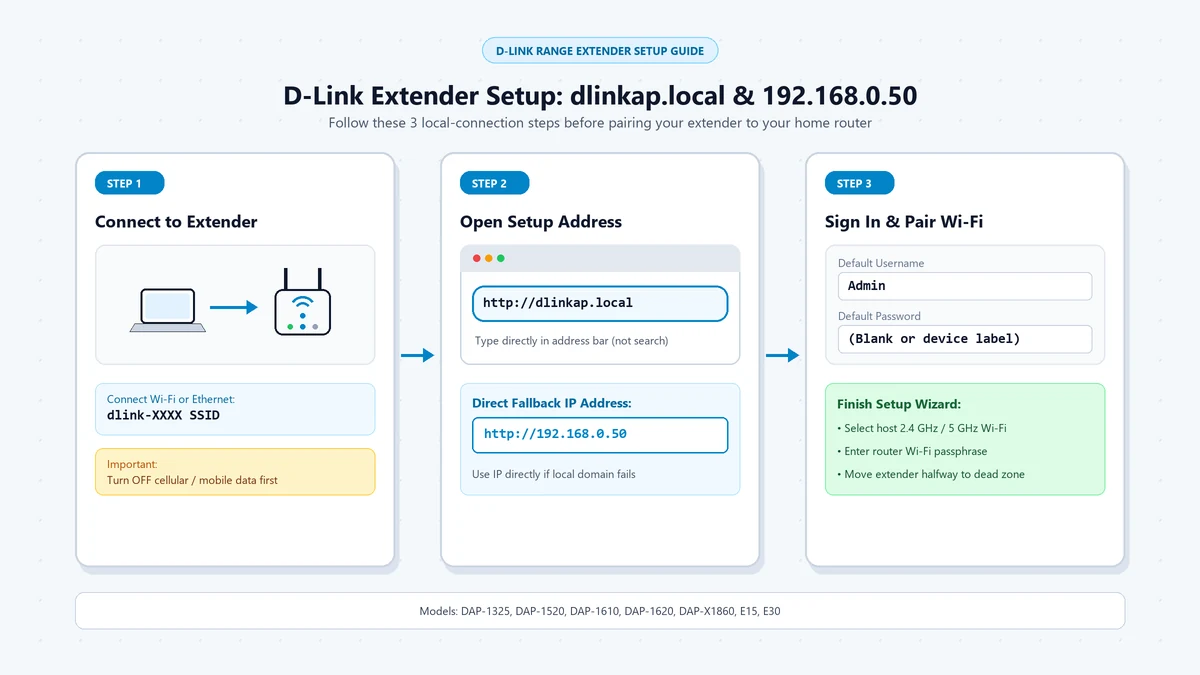
Which D-Link Extenders Use dlinkap.local?
D-Link uses dlinkap.local and 192.168.0.50 across its classic DAP-series extenders and newer AX/E-Series Wi-Fi 6 models.
| D-Link Extender Family | Example Models | Default IP | Setup URL |
|---|---|---|---|
| Classic DAP series | DAP-1120, DAP-1320, DAP-1325, DAP-1330, DAP-1520, DAP-1530, DAP-1610, DAP-1620, DAP-1720, DAP-1755, DAP-1820, DAP-1860, DAP-1955, DCH-M225 | 192.168.0.50 |
http://dlinkap.local |
| Wi-Fi 6 AX / Eagle Pro series | DAP-X1860, E15, E30 | 192.168.0.50 |
http://dlinkap.local |
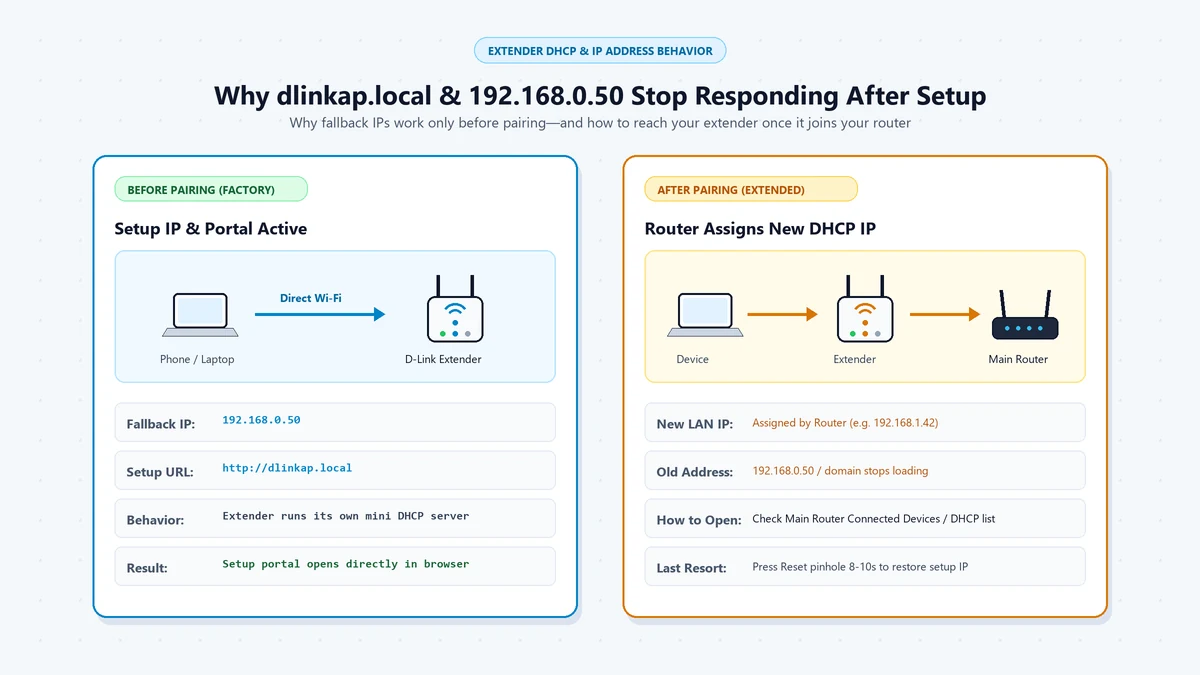
The default address is mainly a fallback IP. After the extender connects to your router in Repeater or Access Point mode, your router assigns it a new dynamic LAN IP through DHCP.
Network Role: Extender vs. Router
| Device | Typical Address | What It Controls |
|---|---|---|
| Main router / gateway | Often 192.168.0.1 or 192.168.1.1 |
Internet connection, DHCP, firewall, primary Wi-Fi |
| D-Link extender before setup | 192.168.0.50 |
Extender setup, Wi-Fi extension, local settings |
| D-Link extender after pairing | New DHCP-assigned IP | Extended Wi-Fi coverage and connected devices |
| Phone, laptop, or smart TV | Assigned by router | Ordinary client device on your network |
So, if 192.168.0.50 does not open your main router’s admin page, that is expected. This address is intended to reach the D-Link extender, not the router itself.
Diagnostic: What Are You Trying to Do?
| Your Situation | What You Actually Need | What to Do |
|---|---|---|
| You want to set up a new D-Link extender | D-Link setup wizard | Connect to the extender and open http://dlinkap.local or http://192.168.0.50 |
| You want to change extender settings | D-Link extender admin page | Connect directly to the extender and log in using the correct credentials |
| You want to log into your main router | Router gateway address | Use 192.168.0.1, 192.168.1.1, or the address printed on your router |
| dlinkap.local will not load | Direct extender connection | Connect to the extender’s Wi-Fi or Ethernet port, then retry |
| The extender is already paired | Its new DHCP-assigned IP | Check the main router’s Attached Devices or DHCP client list |
| You forgot the extender password | Factory reset | Hold the Reset button until the LED changes, then set it up again |
Why dlinkap.local May Not Load
dlinkap.local is not a public website. It is a local address that works only when your device is connected directly to the D-Link extender.
If you are connected to your main router’s Wi-Fi instead of the extender, the browser cannot resolve dlinkap.local. Connect to the extender’s setup Wi-Fi network or use an Ethernet cable, then try again.
Step-by-Step: Set Up a D-Link Extender
Plug in the extender
Place the D-Link extender near your main router during the first-time setup. Wait for it to power on completely before connecting to it.
Connect to the extender
On your phone or computer, open the Wi-Fi list and connect to the D-Link extender’s default Wi-Fi network. The network name and password may be printed on the extender label, Quick Installation Card, or side panel. For newer models such as the DAP-X1860 and E30, use the SSID and password printed on the device label.
Open the setup page
In your browser address bar, enter one of the following:
• http://dlinkap.local
• http://192.168.0.50
Do not type the address into a Google or Bing search box. Enter it directly into the browser address bar.
Log in
For older D-Link DAP models, use:
• Username: Admin
• Password: Leave blank
For newer D-Link Wi-Fi 6 models, the password may be printed on the label, match the host mesh router’s admin password, or need to be created during the setup wizard.
Choose your home Wi-Fi network
The setup wizard will scan for nearby Wi-Fi networks. Select your main router’s network, enter its Wi-Fi password, and follow the prompts to complete the extender setup.
Move the extender to its final location
After setup, unplug the extender and place it halfway between your router and the area with weak Wi-Fi. Do not place it too far from the router, because a weak incoming signal will also create a weak extended signal.
If dlinkap.local Will Not Load
1. Connect directly to the extender
Disconnect from your main router’s Wi-Fi and connect to the D-Link extender’s Wi-Fi network. Alternatively, connect a computer to the extender using an Ethernet cable and disable Wi-Fi on that computer.
2. Turn off mobile data and VPN
On a phone, disable mobile data, VPNs, and proxy settings. The extender’s setup network may not have internet access, and your phone may try to route the request through cellular data instead.
3. Use the browser address bar
Type http://dlinkap.local directly into the browser address bar. Do not search for it in Google, Bing, or another search engine.
4. Try the fallback IP
Enter http://192.168.0.50 in the browser. This address works when the D-Link extender is in factory condition and cannot detect a DHCP server.
5. Check your device IP address (Set Temporary Static IP)
If your device shows an IP address starting with 169.x.x.x or 0.0.0.0, the extender may not have assigned a valid DHCP address. Set a temporary static IP in the 192.168.0.x range, such as 192.168.0.100, with subnet mask 255.255.255.0 and gateway 192.168.0.50. After setup, switch your device back to automatic DHCP.
6. Try another browser or private window
Open an Incognito or InPrivate window, disable browser extensions, and try Chrome, Edge, Firefox, or Safari. This helps rule out cached DNS results, extensions, or browser-security warnings.
7. Find the extender’s new IP
If the extender is already paired, log into your main router and open the Attached Devices, Connected Devices, or DHCP Client List page. Find the D-Link extender, copy its assigned IP address, and enter that IP into your browser.
Factory Reset a D-Link Extender
Reset the extender only if you cannot log in, are moving it to a new router, or the setup page will not load after troubleshooting.
Classic DAP Models
DAP-1320, DAP-1330, DAP-1620, DAP-1860, DCH-M225, etc.
- Keep the extender powered on.
- Find the recessed Reset pinhole (usually on the bottom; side for DAP-1520/1720; top for DAP-1325/1530/1610).
- Press and hold with a paperclip for 10–12 seconds.
- Release when the LED turns red.
- Wait for the extender to reboot.
Newer Wi-Fi 6 Models
DAP-X1860, E15, E30, etc.
- Keep the extender powered on.
- Find the Reset button on the side panel.
- Press and hold with a paperclip for 1–2 seconds.
- Release when the Status LED turns red.
- Wait for the extender to reboot.
You can also reset some D-Link extenders through the web interface by going to Management > System > Restore Factory Defaults.
D-Link Router vs. Extender Login
| Login Type | Address | Default Credentials |
|---|---|---|
| D-Link DAP-series extender | http://dlinkap.local or 192.168.0.50 |
Username Admin, blank password on older models |
| D-Link Wi-Fi 6 extender | http://dlinkap.local or 192.168.0.50 |
Label-printed password, setup wizard password, or host-router password |
| D-Link router | Usually 192.168.0.1 |
Router-specific credentials or password created during setup |
Do not confuse the D-Link extender login with the D-Link router login. D-Link routers commonly use 192.168.0.1, while D-Link extenders use 192.168.0.50 as their factory fallback address.
Common Mistakes
- Trying
dlinkap.localwhile connected to the main router. Connect directly to the extender’s Wi-Fi network or Ethernet port first. - Assuming
192.168.0.50opens the main router. It is the D-Link extender’s factory fallback address, not a typical router gateway address. - Using the wrong credentials. Older DAP models use
Adminwith a blank password, while newer Wi-Fi 6 models may use a label-printed or setup-created password. - Using mobile data during setup. Turn off mobile data, VPNs, and proxies before opening the local setup page.
- Resetting before checking the DHCP list. If the extender is already paired, its new IP may be listed in your router’s client list.
Common Typos to Watch Out For
Misspelling the D-Link extender domain or IP address is the most common reason the setup portal fails to load:
Frequently Asked Questions
No. It is a local setup address used by D-Link Wi-Fi extenders. It only works when your phone or computer is connected directly to the extender’s Wi-Fi network or Ethernet port.
For older DAP-series extenders, the username is Admin and the password is blank. For newer D-Link Wi-Fi 6 models, the password may be printed on the device label, created during setup, or match the host mesh router’s admin password.
The most common reason is that you are connected to your main router instead of the D-Link extender. Other causes include mobile data, VPN interference, browser search behavior, or the extender already receiving a new DHCP-assigned IP address.
Log into your main router and open the connected-devices or DHCP client list. Find the D-Link extender, copy its assigned IP address, and enter that address in your browser.
Yes, depending on the model. Older DAP models may use QRS Mobile, while newer models may use D-Link Wi-Fi, Eagle Pro AI, or AQUILA PRO AI. However, dlinkap.local remains the primary local browser-based setup address for many D-Link extenders.
The Bottom Line
dlinkap.local almost always means you are trying to reach a D-Link Wi-Fi extender, not your main router. Connect directly to the extender, enter http://dlinkap.local or http://192.168.0.50 in the browser address bar, and use the correct credentials for your model. If the page will not load, check the extender’s new DHCP-assigned IP in your router’s client list.
Extender Setup & Mesh Optimization Guides
Detailed walk-throughs for Wi-Fi range extenders, access point configuration, and backhaul: